PUBLICATION
Think Lean, Perform Better
Organisation want to be flexible adjusting quickly to changing market conditions, lean to beat every competitor, innovative to keep its products and services fresh, and dedicated to deliver maximum quality and customer service. While managements want companies that are lean, nimble, flexible, responsive, competitive, innovative, efficient, customer focused, and profitable, many businesses are bloated, clumsy, rigid, sluggish, non-competitive, uncreative, inefficient, disdainful of customer needs, and losing money. Even when companies make money, they do not know how much and where are they losing because of inbuilt wastes, excesses, inefficiencies that have formed as cultural habits. The results that companies achieve are often very different to their full potential. As Bob Nelson writes ‘Companies don’t succeed, people do’, so let us explore the adaptation of good thinking in the mantra’s for success.
Good thinking
Benjamin Disraeli once said: “Nurture great thoughts, for you will never go higher than your thoughts.” The one thing that separates those who rise to the top and those who don’t is - good thinking. Thinking changes feelings, and feelings can become actions. By changing ones actions—based on good thinking—one can change his or her life or the company’s results.
I am not undermining the importance of good education. But the problem with most educational institutions is that they try to teach students ‘what’ to think, and not ‘how’ to think. Knowledge has value only in the hands of someone who has the ability to think well. We must learn how to think well and reach our potential. In the same way, organisations must learn how to think well and reach their potential. Becoming a better thinker is worth your effort because the way you think really impacts every aspect of your life. It doesn’t matter who or what you are, good thinking will make you and your company better.
Here are a few reasons why good thinking is important:
Good thinking creates the foundation for good results: You understand this in the natural world, but try to understand this in the mental and moral world, and cooperate with it. You know that poor thinking can produce only negative results, average thinking produces no result, and good thinking produces some progress but great thinking produces great progress. You cannot change your results without changing your thinking. Remember the proverb ‘as you sow, so you reap’? If you need great results, you need to sow great thinking. Why do you think you fall short of achieving your complete dreams? It is because you are trying to change your results without changing your thinking.
“Where success is concerned, people are not measured in inches or pounds or college degrees or family background; they are measured by the size of their thinking” – David Schwartz
Good thinking increases your potential: Each of us is a leader in some way, be it to our family, to our business, in our community, in our social environment, in our profession, etc. For achieving excellence in manufacturing or any business process, you lead by the way you think, and, your thoughts will lead to actions. You will become as small as your controlling desire or as great as your dominant aspiration. You are that person as you think in your heart. Our leadership ability determines our level of effectiveness. The ceiling on one’s leadership ability is low if one is a poor thinker and that ceiling is high if one is a great thinker.
Good thinking produces more good thinking if you make it a habit: The problems we face today cannot be solved by thinking in the same way we thought while creating them. If you think about excellence, you are bound to produce more of that good thinking. Look around, the world keeps getting more complicated. Psychologists and brain researcher’s tell us that by practicing routine change and being consistent one can create new neural pathways to form new and better daily habits creating pathways to success.
Success comes to those who habitually do things that unsuccessful people don’t do. The more you engage in good thinking, the better your thoughts become. It is like creating an army of good ideas capable of achieving almost anything—example continuous improvement. Everyone has the potential to become a good thinker. Unsuccessful people focus their thinking on survival, average people focus their thinking on maintenance, and successful people focus their thinking on progress.
“Good thinking can never produce bad results; bad thoughts and actions can never produce good results” – James Allen
What then can be good thinking in manufacturing?
What is the ‘how to’ think outline or ‘Mantras for Manufacturing Excellence’? The disclaimer; through populated tool centric teachings and discourses organisations have been led to believe that a random selection of tools will make their business process ‘lean’. It may give some productivity or qualitative improvements, but for the organisation to become lean the leadership must learn how to inculcate and build the practice of daily lean habits into theirs and everyone else’s daily routine. This includes continuous improvements in every functional area.
Identifying the reasons why an organisation wants to become lean, using lean thinking to develop the future state vision, solving the problems in achieving those goals, sequentially using a network of techniques available in the Toyota Production System the way forward. There is no single template that can be used across various industry segments, the lean journey for each company has to be designed individually. Let me introduce a few broad steps in thinking the way towards excellence.
“Don’t wish it was easier, wish you were better. Don’t wish for less problems, wish for more skills. Don’t wish for less challenges, wish for more wisdom” – Jim Rohn
Know the customer: The dominant force in the seller customer relationship has changed since late last century. We are no longer in the seller’s market. Sellers no longer have the upper hand; customers do. Customers tell suppliers what they want, when they want, how they want it, and what they will pay. This new situation is unsettling to companies that have known life only in either the mass market or protected environment. In reality, mass market never existed, but the idea provided manufacturers with useful fiction that their customers were more or less alike. Mass-market suppliers in India had few competitors; they offered very similar products and services. Customers were not dissatisfied. That changed with entry of competition and new offerings. Now that they have choices, customers do not behave as if they are cast in the same mold. They demand products designed for their unique and particular needs. The notion of ‘the’ customer has been replaced by ‘this’ customer. The one with whom the seller is dealing at this moment is the person who now has the capacity to indulge in his personal tastes. The mass market has broken into pieces, some as small as a single customer. The balance of market power has shifted from the producer to the customer.
I have seen this across hundreds of companies that the cause of problems faced downstream have their origin in the functioning of their marketing department, usually caused because of bad planning, over commitment, or lack of lead time and value stream understanding in making commitments.
Eliminate production planning control (PPC) and inspection departments: It is in the experience of most companies having seen forecasted plans change quickly due to market behavior. Then why continue the practice expecting different results? Why not let the customer plan what to produce, in what order and how many quantities?
Lean thinking enables such a change as Mysore Kirloskar demonstrated using measurements, dynamic deep thinking, and simple algorithms. Their factory was a cycle of continuous order inflow from customer and produced to delivering each specific order using first in first out (FIFO) thinking which is an enabler. Inspection must be considered as a non-value adding activity. Not essential. Quality control must be handed over as responsibility to the operators and their jobs enabled by designing failure proofed processes. Initially a few process controllers can go around randomly auditing the quality for reassurance.
Reduce work in process (WIP): The goal of Just-in-Time (JIT) is to ‘add value, not cost’. Counting, recording, data entry, lifting, moving, transporting, storing, searching, accumulating, inspection and such other non-direct value adding activities employ people and resources because accounting may deem it necessary for financial reporting.
The task of material movers, stock keepers, material clerks, expediters, and data entry and processing support staff is non-value adding. Their task of managing the waste, delays, and errors – instead of correcting them - in the system depends on failure to timely make what is needed. These activities add to costs, not value. The goal must be to receive input material, process it fast to completion, deliver to customer and collect money. That’s achievable where the process thinking is one of flow and not of storing, batching or any form of stationery inventory.
Reduce lead times: There are five good zero goals in accidents, defects, lead time, inventory, and changeover times however inordinate they may be; they drive productivity and efficiency and give improved quality is a by-product. There are many believers in the zero defect goal who remain unruffled irrespective of whether or not it is achieved. The number of believers in zero lead time aligned thinking is small even if that is inordinate. Lead-time reduction is a true and reliable dominant measure of efficiency, because a plant can only reduce it by connected flow and solving problems that cause delays. Lead times drop fast when problems are solved fast.
As Albert Einstein said, “You can’t solve a problem on the same level that it was created. You have to rise above it to the next level.” When lead-times reduce, through put times reduce dramatically. From the Mysore Kirloskar case study; when they reduced all lead times to possible minimum their through put times reduced by over 95 per cent, and was one of the contributors that enabled cost reduction by over sixty per cent!
Reduce or eliminate set-up and changeover times: How do you see set-up time? Does skill lie in the set-up or in simplifying it? Are set-up technicians and engineers needed, or operators who lead the projects, with technicians and engineers to help them? Should the operator watch the machine run or should operation be a well-timed routine while the operator is busy thinking about the next improvement? Are assembly jobs simplified so that unskilled labour can perform them or because assemblers can acquire multiple job skills, data collection duty, diagnosis and problem solving talents?
In manufacturing one of the most important type of work-study is change over and set-up time reduction. Product making companies can blend this with standardisation and rationalisation of designs as we saw in Mysore Kirloskar where many setup and changeover times were completely eliminated!
Reduce flow distance and space: The problem that many face in growth is because of their ‘more-of-the-same’ approach. Duplication is in the comfort of habits and culture of the organisations. Reducing flow requires rethinking of the processes, that may lead to innovative design changes. Connected information and material flow, designed without waiting or stoppage can eliminate eighty to ninety percent of all wastes.
When the inventory (in store or WIP) space is made obsolete by efficient process execution, the space used for inventory diminishes or vanishes improving the productive space index. The Just-in-time (JIT) and Jidoka techniques are the best to use coupled with lean thinking to make this transformation possible.
Companies that transform from conventional and become lean, reduce floor space utilised by 30 to 50 per cent.
Reduce through-put time: One technique is to increase the make-delivery frequency for every item. Lean precept is to produce some of every type every day (or at smaller intervals) and in the quantities sold that day, can even be periodic or hourly rate. At Mysore Kirloskar where they strictly produced to orders, some machines had to be produced as one piece or one number only. They had developed the methodology to produce one as fast as they produced many by the use of JIT and standardisation techniques.
Even where they had continuous orders, their production was on an everyday mix of models to be delivered to customers. They achieved this by shortening the batch sizes and short make-delivery times. As William J Bennett has said, “Give yourself an even greater challenge than the one you are trying to master and you will develop the powers necessary to overcome the original difficulty”.
Focus on a few good suppliers: Mysore Kirloskar reduced supplier numbers from 178 to 33. IBM TW Division had reduced suppliers from 640 to 32. Stories like these sure strike fear in the hearts of suppliers. This does not mean that a large number of supplier companies bite the dust. If supplier reduction runs its course then the results should be: a typical supplier plant sells in much larger variety and volume to much smaller number of customers than before. Long-term contracts replace short-term purchases. Supplier receives training, advance planning information, and sometimes even financial assistance and technical support.
Some of the contracts may provide for delivering to a daily or hourly rate rather than batch demands. Buyer takes over making the freight arrangement – like milk run. Supplier development means treating the supplier like a partner. The rationale for supplier development is quality goes up, lead-time and price goes down. Too many suppliers mean too little attention to each one of them; supplier development starts with supplier number reduction.
Standardise and rationalise: Product design owners are best equipped to reduce number of SKU’s or parts. Perhaps the best-known example comes from the Mysore Kirloskar case study. They were battling with fifteen thousand SKU’s or part numbers to configure five basic models. This was a huge challenge given the conventional machine shop and they had to produce one if only one was required.
Reengineering their business process they developed modular designs, applied standardisation and rationalisation thinking to eventually produce about two and a half dozen models (different specifications and configurations) with a basket of parts that now had eight hundred SKU’s or components where half of them were bought-outs such as bearings, electricals, electronics, fasteners etc. They did this by changing from the silos type of departmental organisation structure to the concept of value stream putting together an effective marketing-design-process-procurement-manufacturing team working synchronously like a machine in the pull system. The buying company should not be motivated by benevolence, instead, contractual agreements should be tough so as to drive the supplier into a mode of continual improvement.
Make product manufacturing easy: The designs should enable the manufacturing to control the various processes with available equipment. There is always the argument of adding equipment for processes required. The organisation must take a balanced view on the cost effectiveness. Innovative design changes become necessary for gaining competitive advantage, and depending on the process needs equipment might change; however, lean practice encourages using the first option of modifying existing equipment if feasible before capital investment.
Eliminate search time: I am called to many factories for talk, teach or assist with implementing the Lean Manufacturing system. Quite often standing in the Ohno circle I have seen workmen going to fetch something or the other (tools, gauges, dies, drawings, sometimes material etc.) and in the process end up losing value adding time. Searching or fetching adds to time and cost.
Cross train and multi-skill the work force: The ideal way to plan man power requirement is taking the total quantity required to produce per day and divide it by available time. This will mean operators will have to be multiskilled to move from one process to another depending on need. Process design and layout should be made such that enable this. A cross trained operator grows in skills and talent, enabling him become a better contributor in solving problems and continuous improvement.
Retain production and problem data: Retaining data and learning to use it aids in improving results. Sale data can assist in knowing sale rate and how it varies, allowing proper regulation of material (and information) flow to match demand. Lead time data helps in balancing flow and improving through put times. Order receipt data helps in understanding demand rate, the nature of its variations and aids strategising the execution process. Quality data enables corrections where required to improvements to be made. Attendance data enables correct absenteeism. Financial data will help cost reduction, debtor and creditor status. As in some companies, Mysore Kirloskar measured quality under three major headings – rejections, rework and acceptable deviations that would not harm the functioning of the product. Although their final product quality was excellent certified by TUV Germany and over ninety percent of what they produced was exported to first world countries; the summation of all three deviations totaled thirty three percent (33%), and two plus years late this had come down to zero point three percent (0.3%) through their lean transformation process.
Solve the problem at its place of origin: ‘Nip it in the bud’; ‘Get down to the grass root level’. A problem is best solved at the place it originates. In lean we say ‘go to the Gemba (use your feet), see everything, collect relevant data, ask questions, analyse, brainstorm, hunt for the root cause, find solutions to implement that will eradicate the cause at the root. The data, information and feel are best available at the operator level. Data can be best collected at the functional level – on the Gemba from operators and line supervisors and that is where the problem must be analysed and solved by those very people. Don’t try to do it elsewhere in the comfort of airconditioned cabins. Building quality circles and leaderships’ participation in it is a good practice to achieve this. It motivates the workmen to contribute into making work simpler and environment better. Many times the reason or place where problem originates may be in processes upstream to where it is experienced. Example; the cause for disruptions in production or reason for unwanted inventory accumulation could lie in the way marketing department operates!
Remain dissatisfied with status quo: The idea of Toyota Production System (TPS) was to develop human capital to achieve continuous cost reductions. Lean is a journey on the road to perfection beyond excellence. Every problem solved is a reminder that there are many more ahead, don’t get complacent here. Achievement here is not a destination but only a milestone on the journey to excellence, use it as a cue to set actions in motion for the next goal to be achieved. Keep repeating this step. Be in a hurry for any action that needs to be taken can be completed quickly. Spend time on deep thinking, do not hasten the thinking and brainstorming processes. Better the thinking, better will be the results. Be serious on the good zeros I have explained earlier.
Redesign the business process: Repeated routines create habits, habits establish comforts and blind sight the visibility of wastes. Habits create a culture of complacence. That’s how wastes get hidden, giving rise inefficiencies and costs. Excellence requires great thinking and dynamic actions for qualitative and productive improvements. Using lean thinking, applying JIT and Jidoka techniques it is possible to reengineer the business process usually with existing infrastructure. Visual techniques can automate the processes in signaling further actions making the factory or business process work like a machine. Visual signalling the operations can minimise the need for expensive unnecessary software investments, or keep such investments minimal. Quality improvement is a byproduct of productivity improvement. Give your best shot at improving your existing equipment using preventive or productive maintenance techniques, modify them to suit process needs rather than suiting the process with the machines. Multiskilling and imbibing problem solving abilities in the workforce should be a strategic objective of the management and not just a HR program.
Look for simple, movable equipment: Process is sacrosanct, therefore equipment layout should follow process needs and not the other way around. Thinking simple machines, single standing if necessary, easy to move when layout needs change and can be interconnected for value flow will be an advantage. Equipment should meet daily rate of requirement and not be based on periodic volumes and variability. Entrepreneurial zeal can sometime stump this thinking for long lead time capital items, but there are other risk factors to consider that play a role here. With every process improvement the value stream layout may need to change falling in line with flow principles. Small batch producers find the flexible and easy-to-set-up standalone machines a boon. Volume manufacturers find simple dedicated machines cost effective. The process of continuous improvement involves frequent layout changes. So having machines that can be easily moved around in case of layout changes is a huge advantage. At Mysore Kirloskar processes changed often with improvements, and they had developed the skills of making overnight layout changes irrespective of the machine size.
Have multiple workstations: During the late 1970s and 1980s Mysore Kirloskar considered building a moving assembly line for machines. Practicing ‘group technology’ as manufacturing strategy, was different to flow production. It involved balancing all the background work, and since they produced parts with conventional machines, it meant balancing a lot of cycle times. The strategy was a disabler. But when the company implemented lean manufacturing in the early 1990s, the question that emerged out of JIT and Kaizen learning was different - Is a moving line necessary or a faster workstation? What impact will both have on the floor space and cost? They worked to drastically cut down all lead times. They built demand driven number of workstations that would produce machines to match the daily required rate. It took about one-third of the space that the line would have taken. Balancing the cycle times, the workstation numbers moved up or down with demand. ANZ needed to ship variable number of deck hub assemblies every day, by setting up multiple work stations to balance a three-minute takt time. Factors that determine the station or transfer line are takt time to meet daily demand. In auto or such industries where takt times are low measuring in seconds or couple of minutes investing in a line and automation makes economic sense.
Automate incrementally: At ANZ, they produced spindle bolts in over 15 operations. Eight types of problems confronted them, necessitating extra corrective operations and the pains of rejections, process variations, deviations, non-conformances, and delays. Using problem-solving techniques, they identified that by automating the process they would finish the part in just a few operations, and eliminate the process variability to clear the eight problems once and for all.
Instead of rushing into buying the most suited automated equipment, they have incrementally automated with available equipment to bring all variables under process control. So, automate incrementally to control process variability; and this way you will also keep costs under control.
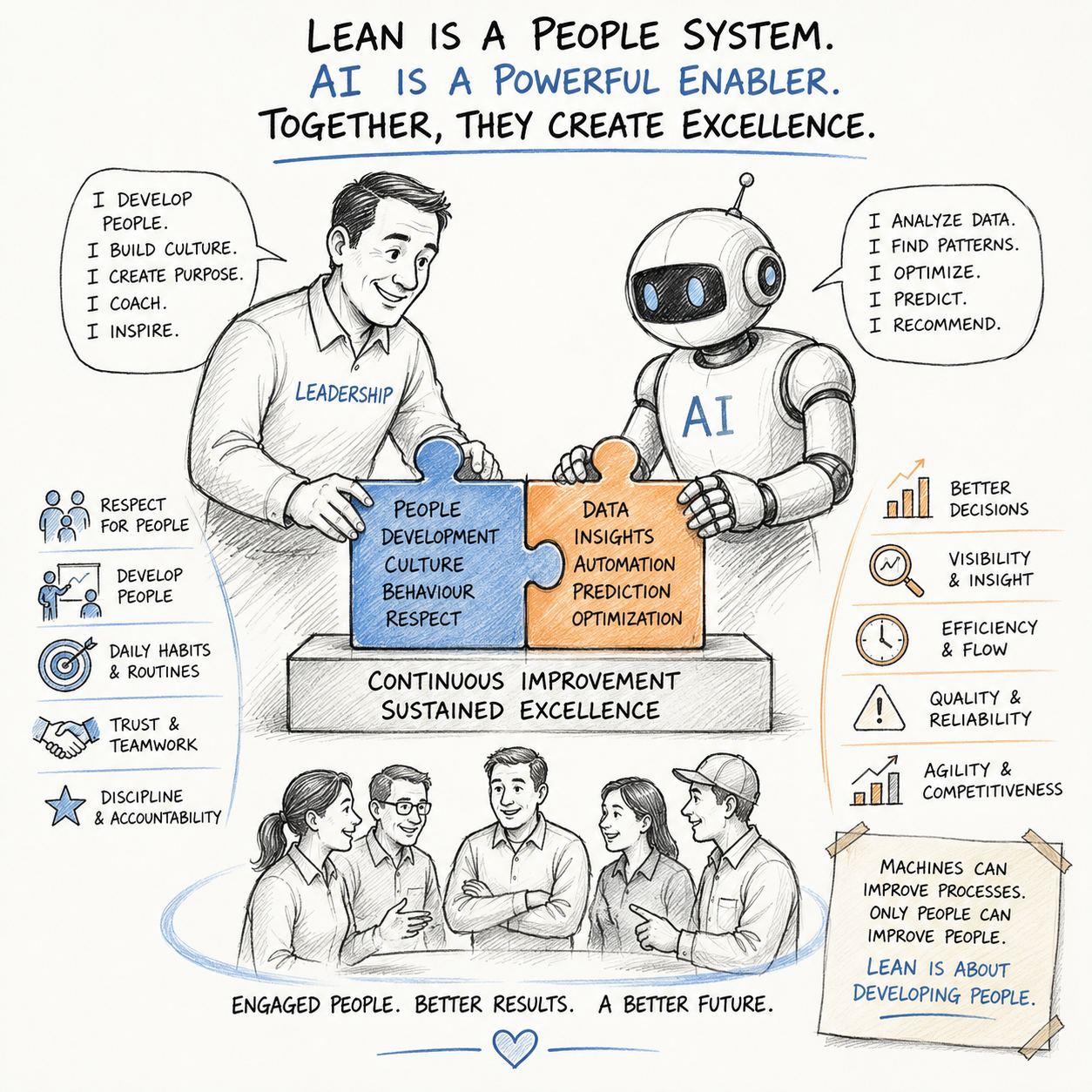
Incremental automation in lean manufacturing allows for gradual, cost-effective upgrades that reduce waste, enhance quality, and boost productivity without disrupting operations. It fosters continuous improvement (Kaizen) by empowering workers, improving safety, and ensuring that technology is applied specifically to bottlenecks, maximising return on investment while maintaining lean flexibility.
Key advantages of incremental automation in lean manufacturing include:
- Minimised operational disruption: By implementing automation in small, staged phases rather than all at once, manufacturers can avoid major shutdowns and keep production running, allowing for testing and adjustments to minimise risks.
- Reduced initial investment & risk: Instead of high capital expenditures for massive, factory-wide systems, incremental automation allows companies to invest in smaller, scalable solutions, reducing financial risk and accelerating ROI.
- Enhanced quality and reduced defects: Automated systems ensure consistent, precise, and accurate production, which helps identify bottlenecks, reduces mistakes, and minimises errors, improving overall quality control.
- Support for continuous improvement (Kaizen): Small automation projects allow for ongoing optimization, aligning with the philosophy of continuous improvement by automating tasks based on specific, identified inefficiencies or hazardous operations rather than replacing the whole process.
- Improved employee engagement and safety: By automating dull, dirty, or dangerous tasks first, worker safety is improved, and employees are empowered to focus on higher-value tasks, often leading to better job roles and motivation.
- Scalability and flexibility: Incremental systems are generally more adaptable to future changes in product design or production volume, enabling factories to stay flexible and responsive to market demands.
- Waste elimination: Targeted automation, such as using robots to eliminate unnecessary motion or automated material handling to reduce inventory, directly supports lean goals of waste reduction (Muda).
Download the original PDF Think-Lean-perform-better.pdf
Download PDF ↓ Originally published in Indian Management · June 2026, pp. 20–29
Keep reading
More on Strategy & Transformation
PUBLICATION
The 'Lean' Edge: Total Lean — The Strategy That Makes Competition Irrelevant
Strategy & TransformationJul 2026
Read → PDF ↓