ARTICLE
Lean Manufacturing vs. Industrial Engineering: Why TPS Is More Than a Toolkit
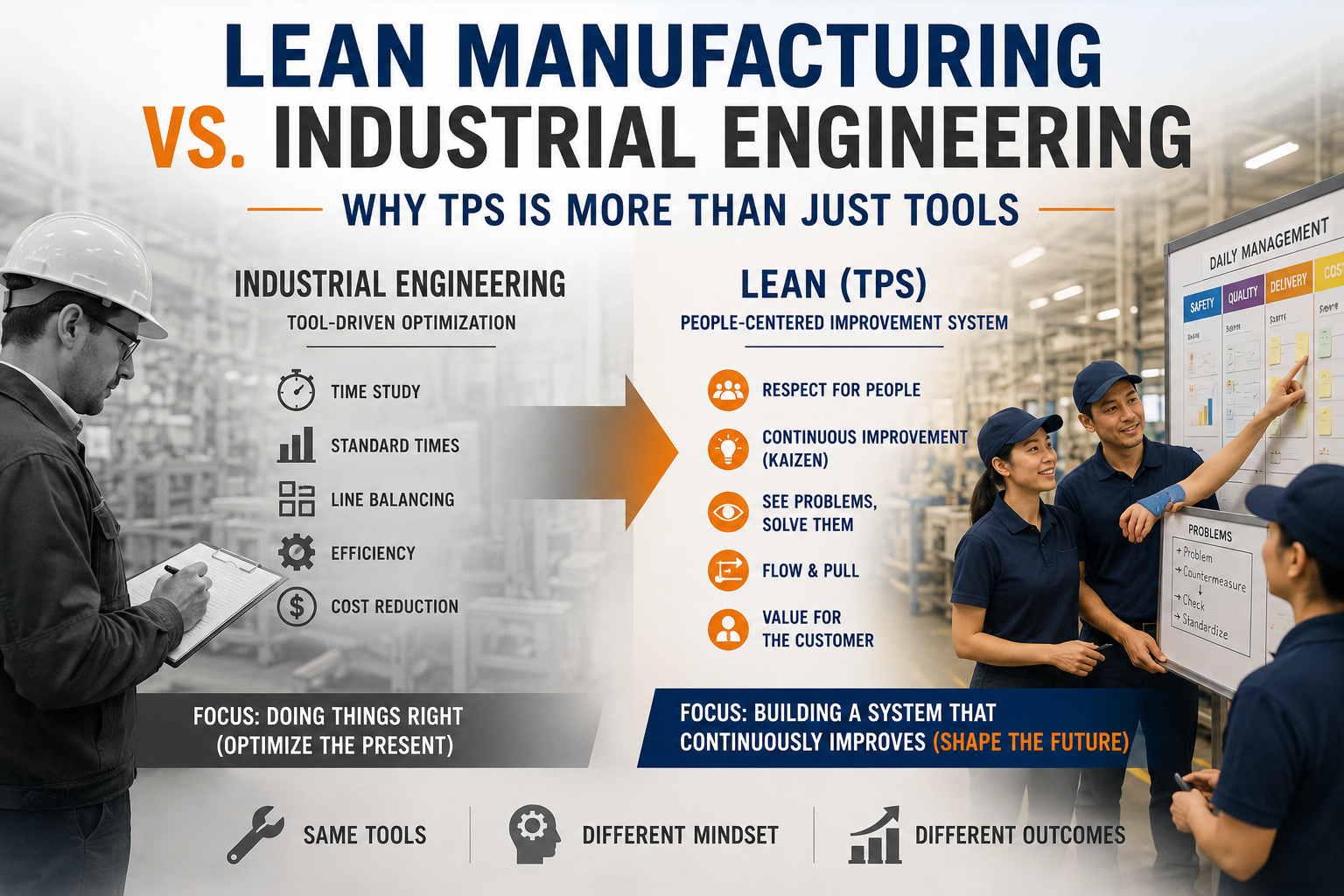
Lean is not just a way to run a business better, but a way to win differently — and keep winning. True Lean elevates itself from an operational method to a boardroom-level competitive strategy. Most writing on Lean stops at tools, implementation frameworks, or culture. A common misunderstanding in many organisations is that implementing Lean by deploying tools — 5S, time studies, line balancing etc. — will deliver transformation. In reality, this approach closely resembles traditional Industrial Engineering (IE) – led productivity improvement. It may yield short-term gains, but it rarely sustains or scales.
This is an important distinction: Using Lean tools without Lean thinking is essentially IE trying to do productivity improvement under a different label.
The Foundation: Industrial Engineering as Optimisation:
Industrial Engineering emerged from the scientific management movement, focusing on optimising tasks, improving productivity, and reducing cost. Its lens is analytical and method-driven: break work into elements, measure time, eliminate unnecessary motion, and design the most efficient method. IE answers the question: “How can this task be done faster, cheaper, and with fewer resources?” It is typically expert-driven — engineers study processes, design improvements, and implement them, often with limited involvement from frontline workers.
The Misstep: Tool-Driven Lean Becomes IE in Disguise: When organisations adopt Lean as a collection of tools, the pattern is familiar:
5S drives are launched and audited
Time studies are conducted to “set standards”
Layout changes are made to improve flow
Productivity targets are pushed top-down
While these activities are valuable, they mirror classical IE interventions. The focus remains on optimisation imposed from outside the process, rather than improvement generated from within the process.
The result?
Initial gains, often significant.
Gradual decline as discipline fades.
Resistance from the workforce (“another initiative”)
Limited or no cultural change. In such cases, Lean has not replaced IE — it has simply rebranded it.
The Transformation: Lean as a System of Thinking: Lean Manufacturing, as embodied in the Toyota Production System (TPS), goes beyond optimisation. It is not just about doing things efficiently — it is about creating a system that continuously learns and improves. Lean asks a different question: “How do we create value for the customer while developing people who can continuously improve the system?” This shift — from efficiency to value, from tools to thinking — is where Lean diverges fundamentally from IE.
Key Differences That Matter
-
From Tools to Philosophy IE is primarily a toolkit. Lean is a philosophy and deep thinking supported by tools. In TPS, tools are secondary; they are used to expose problems and develop capabilities — not just to drive metrics.
-
From Expert-Driven to People-Centric In IE, improvement is often led by specialists. In Lean, everyone is an improver. Operators are not just executors of work; they are problem solvers. Tools like standard work, visual management, daily Kaizen and others are designed to enable this ownership.
-
From Static Optimisation to Dynamic Adaptation IE tends to optimise for a defined condition. Lean builds systems that adapt continuously. Abnormalities are surfaced in real time, and teams are trained to respond immediately - turning every deviation into a learning opportunity.
-
From Cost Reduction to Value Creation IE traditionally emphasises cost efficiency. Lean focuses on value as defined by the customer. Waste elimination is not an isolated goal — it is a byproduct of improving flow and responsiveness. Gains calculated from IE’s productivity improvements done in silos may or not show on the company’s balance sheet, where as gains from true lean system improvements always show on the financial results.
-
From Isolated Improvements to System Thinking IE improvements can be localised. Lean insists on end-to-end flow. It aligns improvements across the value stream, ensuring that gains in one area do not create losses elsewhere.
Why TPS Is More Powerful
The Toyota Production System integrates IE tools into a broader socio-technical system. It combines:
Technical excellence (through IE methods)
Human development (through respect and empowerment)
Management philosophy (long-term, principle-driven decisions)
This integration creates a self-reinforcing cycle: better processes develop better people, better people create better processes and therefore better value. In contrast, when Lean is reduced to tools, it loses this reinforcing loop. It behaves like IE — delivering episodic improvements without building enduring capability.
The Critical Insight
Industrial Engineering is necessary for Lean — but not sufficient. Using tools alone is IE thinking applied harder, not Lean thinking applied differently. True Lean begins when tools are used not just to improve processes, but to develop people who can improve processes every day.
Conclusion
The difference between Lean Manufacturing and Industrial Engineering is not in the tools — they often share the same ones. The difference lies in intent and system design. Industrial Engineering optimises the present. Tool-driven Lean imitates this optimisation. But true Lean builds the capability to continuously transform the future. And that is why the Toyota Production System remains not just a method of efficiency — but one of the most enduring sources of competitive advantage in modern industry.
Keep reading
More on Lean Manufacturing