ARTICLE
Why most companies never become truly lean
Lean manufacturing succeeds when every employee owns both execution and continuous improvement, eliminating waste through standards, problem-solving, and kaizen culture.
Every company—irrespective of size, reputation, market share, or profitability—has waste embedded within its processes. Some organisations may operate more efficiently than others, but no company is completely free from inefficiency. The troubling reality is that most organisations are unable to see these wastes because familiarity normalises them. What people repeatedly experience every day gradually becomes accepted as “the way things are done.”
Employees become accustomed to delays, repeated approvals, excess movement, waiting for information, recurring quality issues, firefighting, duplication of effort, unnecessary meetings, inventory pile-ups, and inefficient communication channels. Over time, these activities stop appearing abnormal. Organisations learn to live with them rather than eliminate them.
Yet these hidden inefficiencies come at a high cost.
Every wasted motion, every delay, every defect, every rework cycle, and every poorly designed process unnecessarily adds cost to the business. Eventually, somebody pays for these inefficiencies. In some cases, the customer pays through higher prices. In highly competitive industries where prices cannot easily be increased, the company itself absorbs the burden through shrinking margins, reduced profitability, lower accruals, and weakened competitiveness. This is why many organisations experience stagnant growth despite strong sales. Revenue may increase, but inefficiencies silently consume profitability underneath.
The obvious question then is: why do intelligent organisations continue to operate this way?
The answer lies at a surprisingly fundamental level—most companies do not truly know how to define a job.
Traditionally, organisations rely on Job Descriptions (JDs) to define work. These are largely influenced by conventional industrial engineering practices and administrative systems. A typical JD explains functional responsibilities, reporting structures, performance measurements, targets, and reward mechanisms. While these may be necessary for organisational administration, they are insufficient for building operational excellence.
Most job descriptions define only what a person must do. They rarely define how the work should evolve or improve.
This creates a serious limitation. Employees become task executors rather than thinkers and improvers. Their role becomes confined to completing assigned activities within departmental boundaries. Improvement becomes somebody else’s responsibility—usually assigned to a separate department, consultants, or through periodic improvement initiatives.
As a result, organisations unknowingly create a culture where maintaining the status quo becomes normal.
Traditional job definitions also fail to incorporate two critical dimensions necessary for long-term competitiveness:
- Human development
- Continuous improvement
A company cannot become lean merely by introducing a buffet of tools, conducting workshops, or implementing isolated improvement projects. Lean is not a toolbox; it is a culture defined by a way of thinking. And culture is built by defining the expectations of every individual in the organisation.
This is where lean manufacturing fundamentally differs from traditional management systems.
Lean manufacturing defines a job not merely as performing assigned tasks, but as a combination of maintaining standards and continuously improving them.
The lean definition of a job is simple, universal, and powerful:
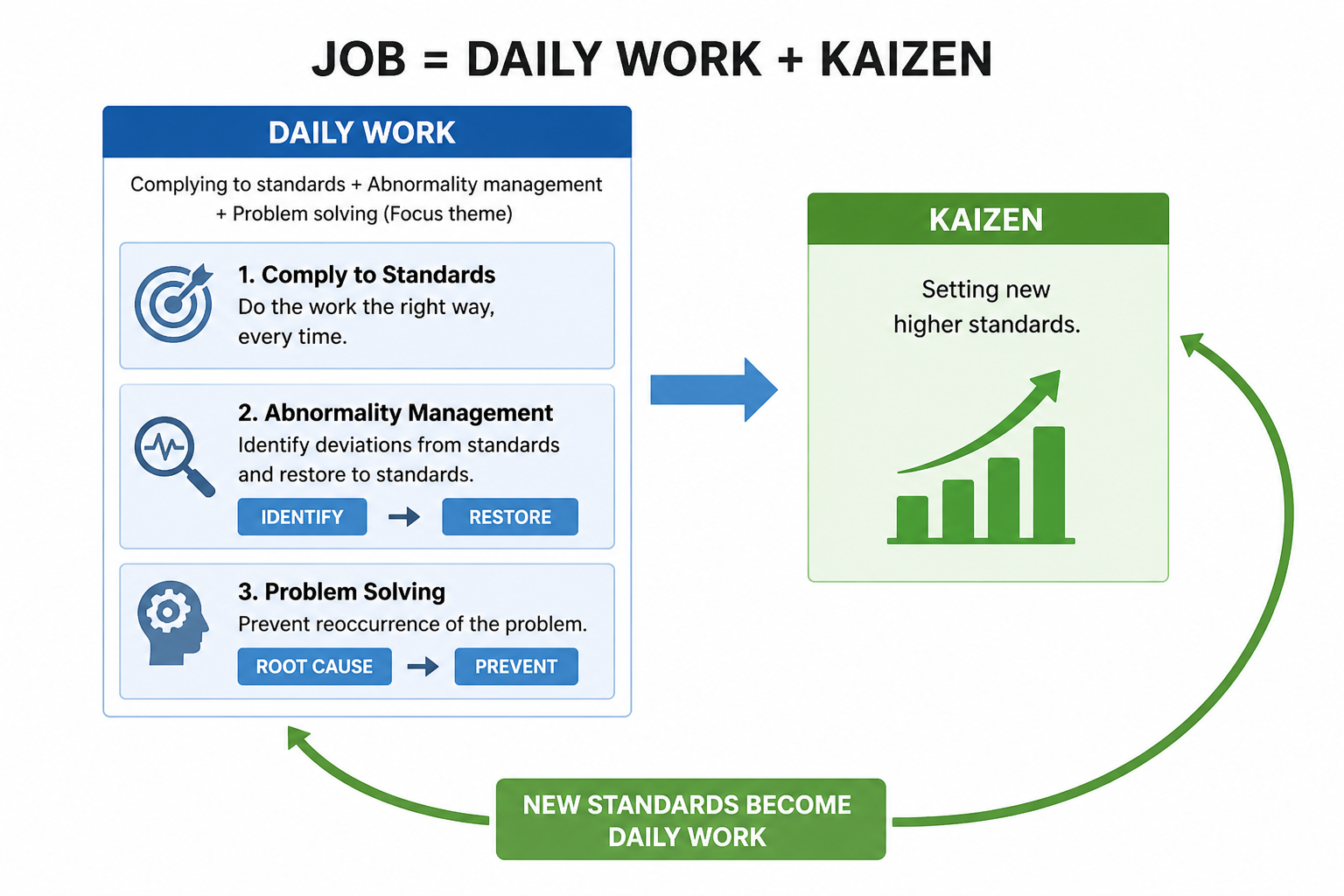
JOB = DAILY WORK + KAIZEN
This definition applies equally to a machine operator, accountant, procurement executive, HR manager, marketing professional, supervisor, plant head, or CEO. Lean does not believe improvement is restricted to manufacturing alone. Every function within the organisation contributes either to value creation or waste generation.
Therefore, every role must carry responsibility for both execution and improvement.
The first component is Daily Work.
Lean defines daily work as:
DAILY WORK = Complying to standards + Abnormality management + Problem solving
The first expectation is compliance to standards. Standards represent the best-known method of performing a task safely, efficiently, and consistently. Without standards, there can be no stability. Without stability, there can be no meaningful improvement.
However, lean recognises that abnormalities will occur. Machines fail, delays happen, quality issues emerge, and processes drift away from expected conditions. The difference in lean organisations is that abnormalities are neither ignored nor hidden.
This brings us to the second element: Abnormality Management.
Abnormality Management = Identifying deviations from standards + restoring to standards.
In lean systems, abnormalities are made visible quickly. The objective is not blame, but restoration. Employees are expected to identify deviations immediately and bring processes back to standard conditions before the issue escalates further.
But lean thinking does not stop there.
Merely restoring conditions is inadequate if the same problems continue to repeat. This is why the central focus of daily work is problem-solving.
Problem Solving = Preventing the recurrence of the problem
This is one of the most defining characteristics of lean culture. Lean organisations do not accept recurring problems as normal operational realities. They seek root causes systematically and eliminate them permanently. Instead of repeatedly firefighting symptoms, they redesign processes to prevent recurrence.
Over time, this dramatically reduces waste, improves productivity, lowers cost, enhances quality, and builds organisational learning.
Yet Lean goes one step further.
Once stability is achieved, organisations must continue progressing. This is where Kaizen becomes essential.
KAIZEN = Setting new, higher standards
Kaizen means continuous improvement. It is the disciplined effort to improve processes, eliminate waste, simplify work, reduce effort, and create better methods continuously. Every improvement becomes a new standard, which then becomes part of daily work.
This creates a continuous cycle:
- Perform work according to standards.
- Detect abnormalities
- Solve problems permanently
- Improve the process
- Establish higher standards
- Repeat continuously
This cycle is what builds genuine lean culture.
The reason many companies fail in their lean journeys is not because they lack commitment, investment, or technical capability. It is because they attempt to implement lean tools without redefining the role of people. They continue operating with traditional job definitions while expecting lean outcomes.
As long as employees are measured only on output and task completion, improvement remains optional. Lean becomes an initiative rather than a way of life.
True transformation happens only when every individual—irrespective of department or hierarchy—understands that their job is not merely to perform work, but also to improve it.
Only then does continuous improvement stop being an event and become a culture.
Download the original PDF Why-most-companies-never-become-truly-lean.pdf
Download PDF ↓ Originally published in Manufacturing Today India · 2026-05-21
Keep reading
More on Lean Manufacturing

ARTICLE
Lean Manufacturing vs. Industrial Engineering: Why TPS Is More Than a Toolkit
Lean ManufacturingMay 2026