ARTICLE
The Enterprise Lean Habits
“Lean” has become a cliché’, one of the most discussed and misinterpreted concepts in modern management. It is admired for the benefits it can deliver to customers, pursued enthusiastically by many CEOs, celebrated by the successful few, questioned by skeptics, and often reduced to superficial tool implementation by many others. Despite decades of discussion and training, truly successful Lean transformations remain rare. Various surveys indicate differing rates of success, but those suggesting success in single digits are perhaps closer to reality. The question is: why?
The answer lies in how Lean is understood and practiced.
Lean is often described narrowly as cost reduction, inventory reduction, waste elimination, 5S, TPM, Kanban, Lean Six Sigma, or continuous improvement and a few other tools. While these may be associated with Lean, none of them individually represents the true essence of the Toyota Production System (TPS) or Lean. Such fragmented understanding has led organisations to implement Lean as isolated tool modules rather than as a seamless management philosophy focused on human development, organisational transformation, and value creation.
When Lean is viewed merely as a collection of tools, organisations naturally develop into departmental silos instead of integrated value streams. Work becomes centered around delegation rather than ownership, compliance rather than commitment, and instructions rather than disciplined habits. In such systems, inefficiencies remain hidden, unnecessary costs continue to exist, and the organisation falls far short of its full potential.
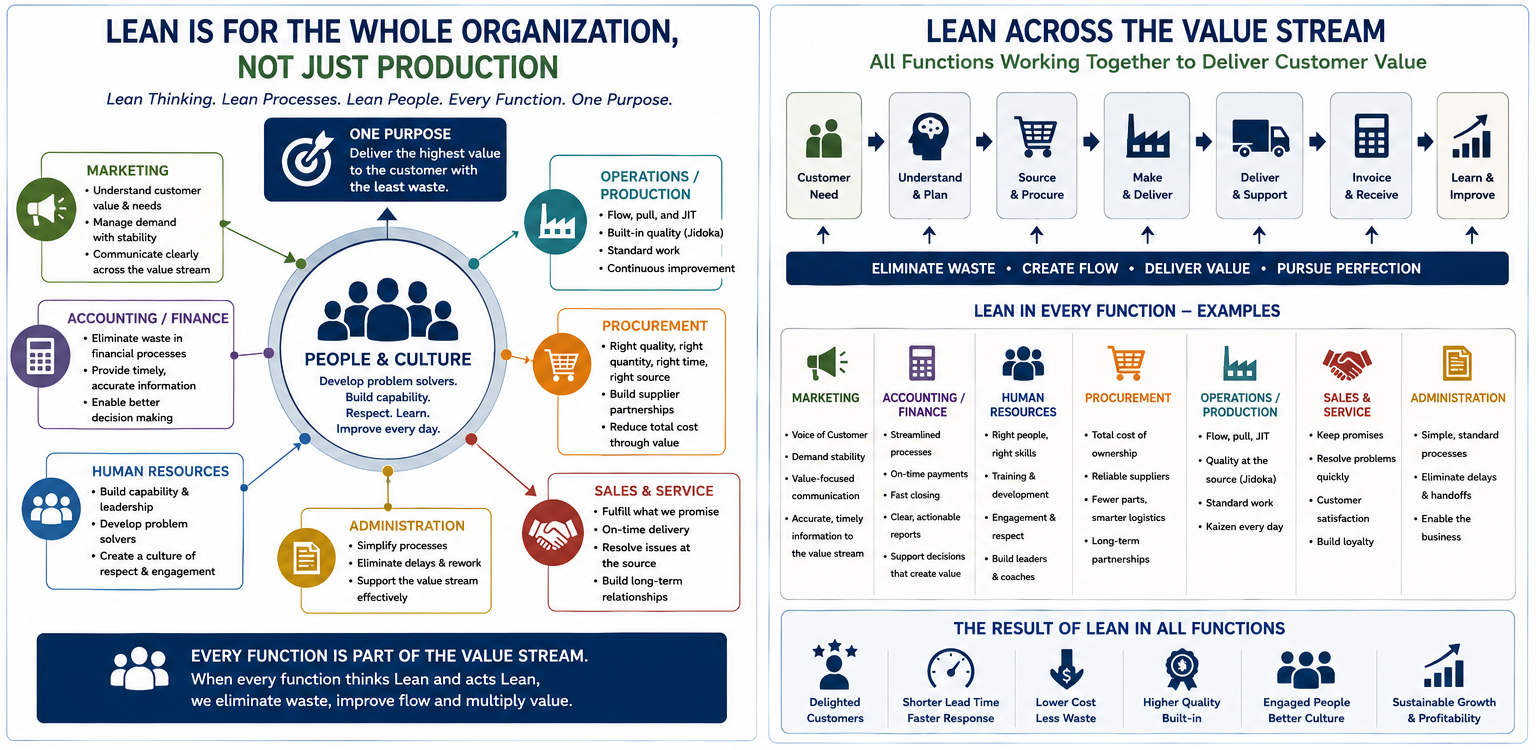
The Toyota Production System is fundamentally based on the philosophy of pursuing the complete elimination of all waste in the pursuit of perfection. The word “all” is critical. It includes every individual, every process, and every function in the organisation — from the CEO to the last vendor, and from marketing to design, manufacturing, finance, administration, procurement, human resources and administration.
TPS became coined as Lean Manufacturing for wider application, though it is far more than just manufacturing methodology. Before the term Lean was coined, it was widely known as the Just-in-Time (JIT) system — a superior way of delivering value to customers through speed, quality, flexibility, and efficiency.
Toyota developed this system over many decades through observation, experimentation, learning, and relentless improvement. The objective was simple yet profound: produce exactly what the customer wants, in the quantity required, at the right time, and deliver it with the least possible waste.
TPS rests on two foundational pillars: Jidoka and Just-in-Time.
Jidoka, often described as “autonomation with a human touch,” ensures that whenever a problem occurs, the process stops immediately so that defects are not passed forward. Problems are exposed rather than hidden.
Just-in-Time ensures that every process produces only what the next process needs, in the quantity needed, and at the time needed. This creates smooth flow, eliminates excess inventory, reduces delays, and enables rapid response to customer demand.
Together, these principles enable organisations to produce high-quality products and services efficiently, economically, and responsively. More importantly, they create a culture where problems are continuously identified and solved.
This culture — not the tools alone — is the true source of Toyota’s competitive strength.
Many organisations fail with Lean because they attempt to copy visible tools without understanding the deeper philosophy and behavioral discipline behind them. Lean success is not achieved through isolated Kaizen events or occasional improvement workshops. It comes from cultivating an organisational mindset centered on problem-solving, learning, accountability, and continuous improvement.
The social and cultural transformation of people is therefore more important than mechanistic measurement systems or isolated efficiency projects.
Just-in-Time manufacturing significantly improves productivity because it is based on the principle of making only what is needed, when it is needed, and in the exact quantity required. However, this capability cannot exist only inside production. It must extend across the entire business system.
Lean in Marketing
Traditional marketing practices often rely on annual forecasts that are repeatedly revised throughout the year due to changing customer demand and market volatility. Markets are dynamic by nature and rarely behave according to static assumptions.
The real challenge is not forecasting perfectly; it is developing the organizational capability to respond to variation without wasting resources.
For over a century, traditional manufacturing systems attempted to manage variation through excess inventory. The result was organizations becoming heavy, slow, inflexible, and inefficient. Lean thinking takes a fundamentally different approach. Instead of building inventory against uncertainty, Lean organizations develop systems that respond rapidly to actual customer demand.
Resources are consumed only against real demand, not assumptions.
This requires an entirely different way of understanding demand, planning production, and managing flow. Traditional forecasting methods often fail because they focus on prediction rather than responsiveness. Lean systems, on the other hand, focus on measuring actual consumption patterns and designing processes that can absorb variation without generating waste.
This is why Lean implementation must begin with understanding customer value and developing a value-delivery strategy. Weak or inconsistent marketing practices create instability that disrupts both JIT and Jidoka. Without disciplined demand management, Lean execution becomes difficult.
Therefore, Lean habits must also be cultivated within marketing functions. Marketing cannot remain disconnected from operations. It must become an integral part of the value stream.
Lean in Accounting
Accounting departments often assume Lean does not apply to them because accounting has traditionally been viewed as a transactional and reporting function. However, Lean accounting is not about merely changing financial formats; it is about transforming how accounting supports the business.
Conventional accounting focuses on completing transactions, closing books, preparing reports, and adhering to timelines. Lean accounting shifts the focus toward supporting value creation and eliminating waste from financial processes themselves.
In traditional systems, customers of accounting functions frequently experience delays, approvals, bottlenecks, and unnecessary complexity. Lean accounting seeks to eliminate these inefficiencies.
Paying invoices on time without last-minute escalations, simplifying approval flows, closing books without excessive overtime, reducing delays in billing processes, and creating transparent financial systems are all examples of Lean thinking in accounting.
Lean accounting requires a different mindset. It asks finance professionals to examine their own processes critically and continuously improve them in the same way production processes are improved. When accounting becomes aligned with Lean principles, it ceases to be merely a reporting function and becomes an active enabler of operational excellence.
Lean in Human Resources
Human Resources is another function frequently excluded from Lean transformation efforts. When HR is viewed purely as an administrative department, its role becomes limited to recruitment, compliance, payroll, and policy management.
In a Lean organization, HR must become a strategic partner in organizational transformation.
The role of HR is not only to manage people, but to help develop problem solvers. This requires HR professionals themselves to deeply understand Lean philosophy and practice it within their own work.
Lean organizations require people who can think critically, solve problems collaboratively, and continuously improve systems. HR therefore plays a crucial role in skill development, leadership development, team engagement, and cultural reinforcement.
The responsibility is not simply to manage manpower but to create an environment where people grow intellectually and professionally. This broader and more strategic role of HR is essential for long-term Lean success.
Endless Pursuit of Excellence
One of the greatest dangers in any improvement journey is complacency.
Many managers become satisfied after achieving some visible improvements. They reach acceptable performance levels and stop pushing further. But Lean is not a destination. It is a never-ending pursuit of excellence.
A story shared by Mike Hoseus beautifully illustrates this mindset.
After years of improvement work at Toyota, his team had achieved near-zero defects and zero incidents. Their performance indicators were entirely green. Proud of the accomplishment, he expected recognition and perhaps some relief from the relentless pursuit of improvement.
Instead, his Japanese mentor reviewed the results and said: “You have no problems here — and that is a big problem.”
The lesson was profound.
The objective was never simply to achieve green metrics. The real objective was to create people capable of identifying deeper problems, challenging existing assumptions, and continuously improving processes.
The mentor encouraged the team to go further — to identify work that added no value and eliminate entire unnecessary processes. That was when the true role of leadership became clear: not merely delivering results, but developing an army of problem solvers.
This is the mindset that must exist throughout the organization — from the CEO to the last person in the value chain.
Success should never lead to complacency. Excellence demands passion, discipline, humility, and perseverance. Lean succeeds not because of occasional initiatives, but because of consistent daily habits practiced over long periods of time.
And these habits must begin with leadership.
The CEO cannot delegate Lean culture. Leaders must personally demonstrate the discipline, behaviors, routines, and commitment they expect from others. This is one of the primary reasons many Lean transformations fail. Organizations attempt to implement Lean operationally without embracing it behaviorally.
Successful Lean transformations are always led by deeply committed leaders who understand that sustainable results come from developing people’s ability to think and solve problems.
Results are outcomes of processes. Therefore, focusing on improving processes is more important than merely chasing results.
Toyota is known to use over ninety different problem-solving tools within its management system. Yet the tools themselves are not the source of Toyota’s success. Their success comes from disciplined behavior, shared routines, relentless learning, and organizational habits consistently practiced throughout the company.
Randomly applying a few Lean tools does not create a Lean organization.
Improvement efforts isolated from the larger value stream often fail to impact profitability because gains in one area are offset by waste elsewhere. True Lean transformation requires enterprise-wide alignment.
Toyota reportedly received over forty million employee improvement suggestions many years ago. Today, the number would undoubtedly be far higher. What is remarkable is not merely the volume of suggestions, but the culture that encourages every individual to think, contribute, and improve continuously.
That is why companies across the world admire Toyota’s results.
But Toyota’s success does not lie merely in its tools or systems. It lies in its culture, attitudes, discipline, and habits.
As Taiichi Ohno famously said, people do not go to Toyota merely to work — they go there to think.
Any CEO who can cultivate such a culture within their organization will not merely implement Lean. They will build an institution capable of enduring excellence
Keep reading
More on Lean Manufacturing
ARTICLE
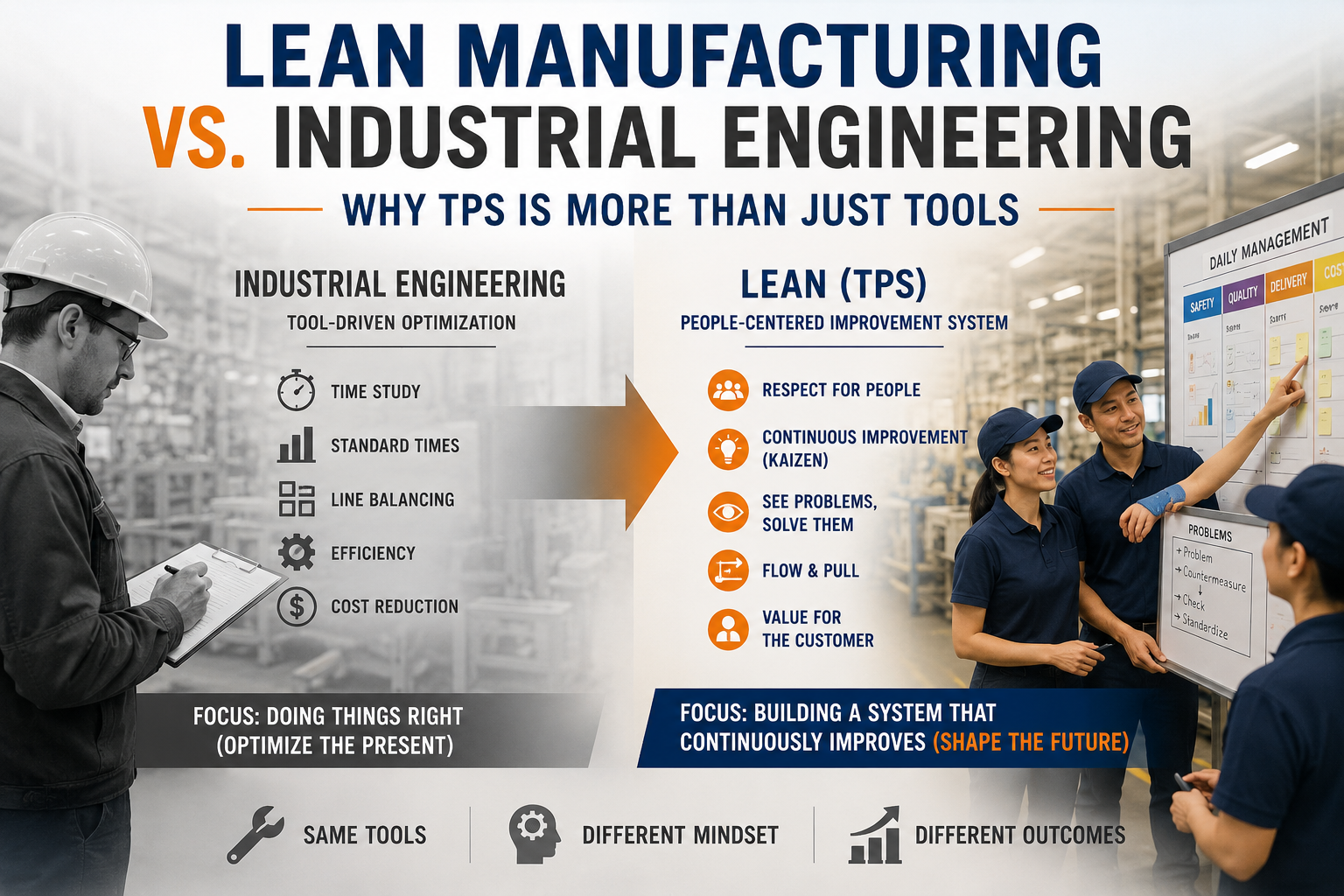
Lean Manufacturing vs. Industrial Engineering: Why TPS Is More Than a Toolkit
Lean ManufacturingMay 2026